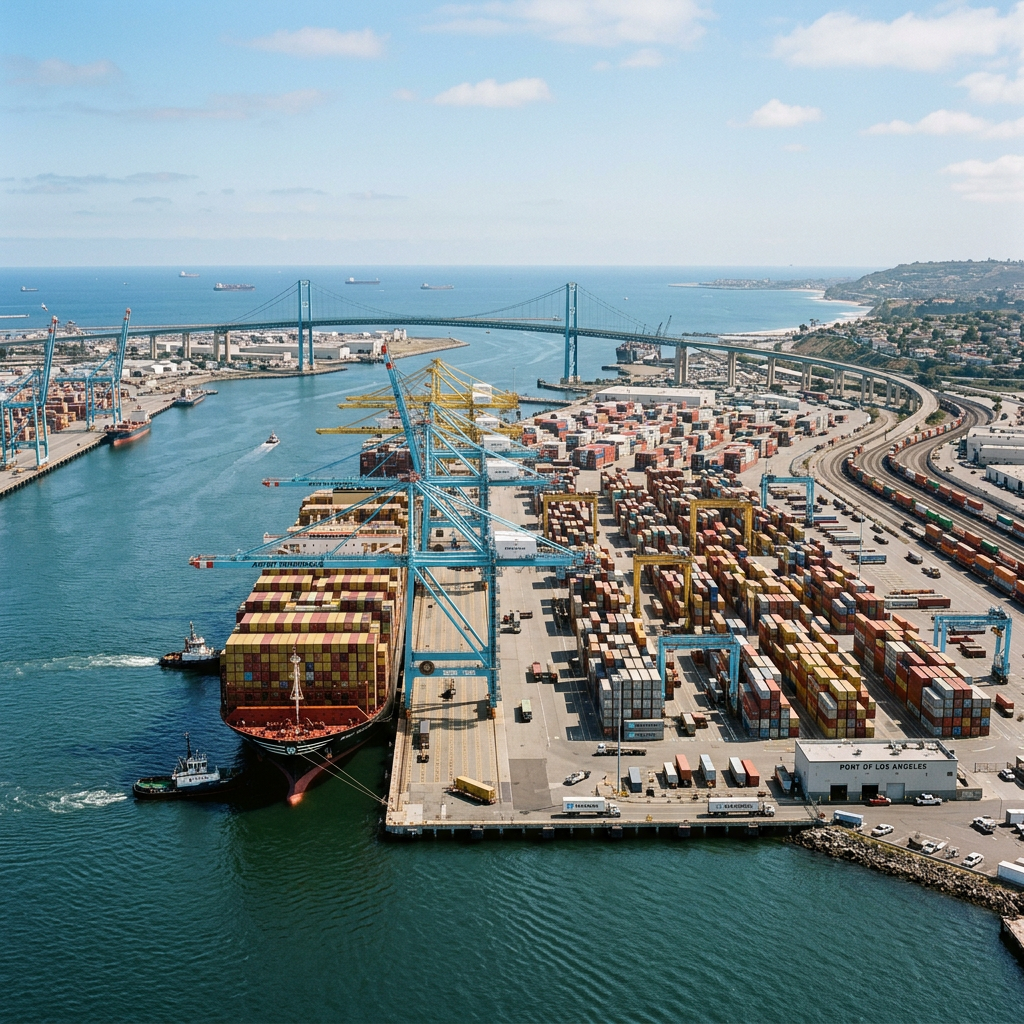
The Port of Los Angeles handled 1,042,652 TEUs in September 2026, the busiest month in its 118-year history. In fact, it beat the previous record, set in July 2025, by more than 20,000 TEUs. The port announced the figures on October 9.
Moreover, September capped a record run. The July–September quarter brought in nearly 3 million TEUs, the port’s best quarter ever. Similarly, June through September was its strongest four-month stretch on record.
The numbers
Imports drove the record. Loaded imports rose 19% from a year earlier and came in 26% above the five-year September average, according to Maritime Executive.
| Measure (September 2026) | TEUs | Change vs. Sept 2025 |
|---|---|---|
| Total volume | 1,042,652 | All-time monthly record |
| Loaded imports | 545,696 | +19% |
| Loaded exports | 125,751 | +10% |
| Empty containers | ~371,206 | Highest month on record |
| Year to date (Jan–Sept) | ~8.1 million | +3% |
Exports grew too, but they remain soft. As a result, the port shipped a record number of empty containers back to Asia.
Why volume surged
Port Executive Director Gene Seroka pointed to three main drivers. First, consumer demand “remains resilient.” Second, importers are restocking inventories. Third, shippers are moving more cargo to Los Angeles because of disruptions elsewhere, including the Red Sea and Suez Canal routes and Panama Canal restrictions.
Tariffs also played a role. According to Seroka, tariffs are lower than earlier in 2026, which gives importers more certainty about costs. In addition, last month’s extension of the U.S.–China trade truce to January 10, 2027 opened a window to move large volumes.
“September was a month for the record books, and it was part of an extraordinary run for the Port of Los Angeles,” Seroka said.
Meanwhile, Harvard Business School professor Willy Shih described a broader shift in how companies plan. “Companies are moving from purely optimizing for cost to optimizing for options,” he said in the port’s release.
What it means for shippers
The port expects volume to ease to about 900,000 TEUs in October. However, November and December are harder to call. Retailers have already built inventory, but Chinese cargo backlogs remain after two typhoons disrupted port operations, according to Maritime Executive.
With that in mind, here is what BCOs should watch:
- Drayage and chassis. Record imports and empties strain trucks, chassis and terminal appointments. Therefore, confirm dray capacity before vessels arrive.
- Local congestion. The Vincent Thomas Bridge at the port is set to close November 1 for 16 months, according to Intelligent Audit. As a result, expect longer truck routes around the terminals.
- Intermodal limits. Rail capacity out of Southern California may tighten as volume rises. Consequently, some inland moves could shift to over-the-road trucking at higher cost.
- The January 10 tariff deadline. If the U.S.–China truce is not extended again, another rush of imports could follow. Until then, plan inventory with that date in mind.
- Gateway options. Finally, Los Angeles is gaining share because other routes are disrupted. Keeping a second gateway in your plans protects you if conditions change.