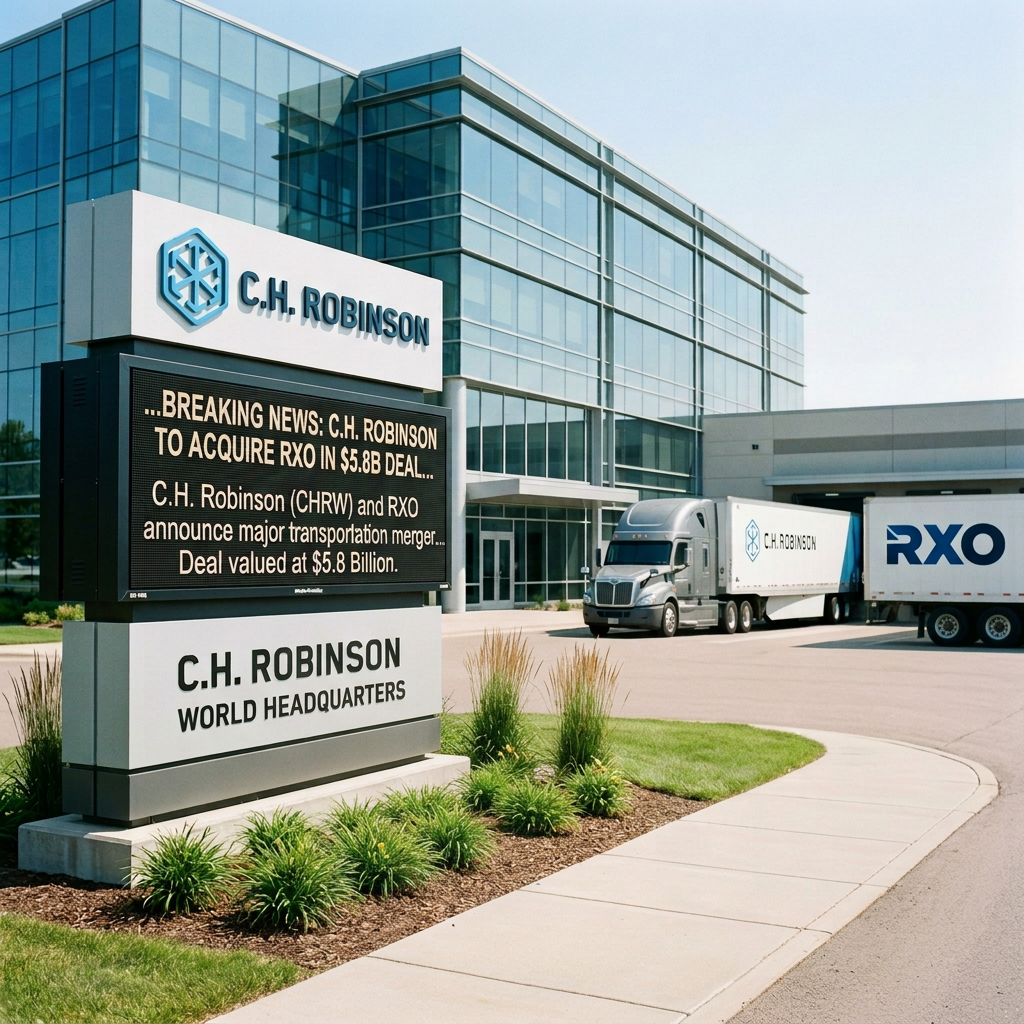
C.H. Robinson announced on October 5, 2026 that it will acquire RXO in a cash-and-stock deal worth $5.8 billion. As a result, the No. 1 and No. 3 U.S. truck brokers will become one company, with an enterprise value of more than $25 billion. In fact, FreightWaves calls it the largest brokerage deal ever.
Under the terms, RXO shareholders will get $17.25 in cash plus 0.0856 C.H. Robinson shares for each RXO share, worth $30.25 in total. That is a 29% premium to RXO’s October 2 closing price and 27% over its 90-day average. Alternatively, shareholders can choose all cash or all stock. Once the deal closes, they will own about 11% of the combined company.
Both boards approved the deal unanimously. However, it still needs regulatory approval and an RXO shareholder vote, so it is not expected to close until the first half of 2027. Meanwhile, MFN Partners, which holds about 17% of RXO, has already agreed to vote for it.
Investors, however, split on the news. In premarket trading, RXO jumped about 23% to $28.74. By contrast, C.H. Robinson fell about 9% to $144.
Why C.H. Robinson wants RXO
First, C.H. Robinson expects $300 million a year in net cost savings within two years of closing. These savings would come from shared services, combined operations, lower outside spending and a lower cost to serve each shipment. In particular, FreightWaves expects much of it to come from running everything on C.H. Robinson’s technology and closing duplicate offices.
“This transaction is a natural next step in our transformation, allowing us to create a more scaled, resilient North American third-party logistics provider,” said Dave Bozeman, C.H. Robinson’s president and CEO.
Since Bozeman took over, C.H. Robinson has cut costs and leaned heavily on automation and AI in its brokerage. RXO, on the other hand, has posted ten straight quarterly net losses, according to FreightWaves. On top of that, it has been absorbing Coyote Logistics, which it bought from UPS in 2024. In short, C.H. Robinson is betting that its lower-cost model can run RXO’s freight more profitably.
After closing, RXO will be folded mostly into C.H. Robinson’s North American Surface Transportation (NAST) division. For his part, RXO chairman and CEO Drew Wilkerson called the deal “an exciting next chapter for our company, our employees and our customers.”
Financially, C.H. Robinson expects the deal to add to adjusted earnings per share within nine months, and by a mid-teens percentage in 2028. To fund the cash portion, it will take on new debt. In addition, it will stop buying back shares until its leverage falls back to 1.75–2.25 times EBITDA, which it targets by the end of 2028.
What it means for the brokerage market
Overall, the deal makes the biggest U.S. truck broker much bigger, at a time when the freight market has been weak for several years. According to analysts quoted by FreightWaves, “the whole world has changed” for 3PLs. Consequently, mid-sized brokers will now compete against a company with far more scale in carrier networks, data and technology spending.
Still, some investors are worried. For example, the roughly 9% drop in C.H. Robinson’s stock reflects concerns about combining two large brokerages and taking on new debt. Moreover, large brokerage mergers have struggled before, especially with keeping customers and carriers. On the positive side, the ratings agencies have said the combined company will stay investment grade.
What shippers should watch
- Fewer big options. If you use both brokers, you’ll have one less large broker bidding on your freight. Therefore, check how much of your volume goes through each one and line up backup capacity before the deal closes.
- Contract and platform changes. Over time, expect RXO customers to be moved onto C.H. Robinson’s systems. In the meantime, find out which of your rates, service terms and integrations will carry over.
- Account team turnover. Combining offices usually means losing staff. For that reason, make sure you know who will handle your account after the merger.
- Carrier relationships. Carriers that hauled for both brokers will now deal with one company. As a result, watch for changes in coverage on tight lanes.
- The timeline. Nothing changes for customers until the deal closes, expected in the first half of 2027. Until then, use the time to plan.